

 2:36
Build
When to graduate from Replit or Lovable, and how.
Recognize when your product needs to move beyond Replit or Lovable.
Loading Academy…
Designli Academy
Practical lessons for non-technical founders. Find your footing, build a better product and work through what comes next.
Explore the libraryGrow lesson
Talk one-on-one with Carlos Sanabria about what to build, finding customers or getting growth moving. Bring your current challenge and work through a practical next step together.
Book a 1:1 Mentorship CallEvery week, the product and technical side: scoping, architecture, AI-built code and deciding what to build next.
2:36Recognize when your product needs to move beyond Replit or Lovable.
 1:40
Turn an assumption into a hypothesis you can test.
 3:55
Connect the stack stages to the concrete security, reliability, cost and operational triggers for a change.
 2:33
Connect hard-to-reverse choices with delivery metrics and questions to ask your engineers.
 5:30
Connect recognizable design, clear workflows and a faster path to first value.
 3:32
See how confirmations, errors and workflow feedback help users understand what happened.
 2:44
Review three concrete failure patterns: exposed secrets, missing permissions and browser-controlled pricing.
 5:27
Follow the link between tangled architecture, technical debt and automated tests.
 6:05
Go from delivery bottlenecks to the RICE example, scoring factors and calculation.
 2:30
Turn undocumented decisions into context that supports onboarding, delegation and handoff.
 2:45
Walk through tests, staging, review and production, then connect the safeguards to a real failure.
 3:43
Use the decision tree and closing checklist to select the fix your product actually needs.
Every week, the go-to-market side of the same problem: first customers, pricing, positioning and sales.
 3:41
Find the growth constraint before trying another tactic.
 3:29
Use three questions to find where growth is getting stuck.
 3:06
Understand the gap between the product you built and the value customers see.
 3:01
Look at your product from the customer’s perspective.
 4:08
Choose a North Star metric that connects the work to customer value.
 3:15
Make room for the work that matters by saying no.
 1:22
Sort growth ideas into quick wins, big bets and work to stop.
 3:54
Use competitor reviews to learn what customers still need.
 1:39
Understand the reasoning behind a competitor’s choices.
 3:13
Test a new market with the focus of a startup.
 4:43
Move from the four-layer GTM pyramid to a concrete map of your buyer’s ecosystem.
 3:43
Work from customer pain to a clear outcome, proof, lower risk and a price to test.
 3:17
Pair useful expertise with channels that match the buyer’s real behavior.
 3:05
Build a measurable experiment, then use the diagnostic tree to find what to fix next.
 3:26
Connect a clean data foundation to one core asset and its distribution across channels.
 4:12
Follow the tools from channel work and measurement through call coaching, CRM updates and follow-ups.
 4:26
Use the readiness check, then decide whether your stage needs an architect or an operator.
 3:36
Combine the SDR-versus-AE decision with a practical candidate-fit checklist.
 5:44
Connect the forces-of-progress framework to the actual interview questions that reveal buying behavior.
 4:26
Follow the survey question, segmentation and Superhuman example through to a product decision.
 4:50
Work through pivot types and the keep-or-change canvas, with the Twitch example.
 4:42
Move from the funnel and activation stages to an onboarding example and retention comparison.
 3:07
Read the three retention patterns, then connect each one to a different product or market diagnosis.
 2:45
Combine quantitative and qualitative signals, then map the path to retention and the changes that support it.
Conversations with founders about building a business, leading a team and learning through experience.
 52:22
Episode 16
Geoff Wasserman explains how The Brand Leader grew through shared leadership, financial transparency, focused roles, and a culture that puts people first.
 39:10
Episode 15
Marty Osborn shares lessons from building a service company, including deliberate hiring, shared rewards, stronger relationships, and giving up control.
 30:55
Episode 14
Brandy Amidon shares how she moved from accounting to agency ownership, built trust through change, and made support for employees part of daily work.
 40:12
Episode 13
Designli founders Keith Shields and Josh Tucker discuss service business growth, customer expectations, repeatable processes, hiring, and cash flow planning.
 29:38
Episode 12
Caroline Jennings shares how Word of Web grew from a website for her dad into a remote team, with repeatable services, clearer boundaries, and new priorities.
 23:09
Episode 11
Boyd Cycling co-founder Nicole Johnson shares lessons on product focus, a costly supplier failure, supporting employees, and asking for experienced help.
 24:09
Episode 10
Didi Caldwell explains how Global Location Strategies grew through patient investment, trusted teams, and technology built from its consulting expertise.
 29:35
Episode 9
Kenzie Biggins shares how WorxBee found its service model, why break-even analysis mattered, and how she approaches funding, leadership, and boundaries.
 25:23
Episode 8
Peter Micali of NEXT shares lessons from a nutrition startup and startup accelerators on finding useful support, telling your story, and asking for help.
 29:27
Episode 7
Michael Mino shares lessons from startups and business restarts on choosing partners, evaluating ideas, and building a company that fits your life.
 34:25
Episode 6
Paige McPheely explains how Base combined software and assistant services, what fundraising taught her, and why respect shapes her approach to growth.
 31:29
Episode 5
Scott Millwood shares how Customer Effective won its first client, how Yesflow tested adoption, and why founders need customers, strong teams, and mentors.
 46:03
Episode 4
6AM City co-founders Ryan Johnston and Ryan Heafy explain the funding, training, delegation, and culture behind their expansion from seven to 24 cities.
 34:04
Episode 3
Lelia King explains how Build Carolina grew beyond a coding school, why some programs need to stay small, and how she learned to lead through uncertainty.
 20:26
Episode 2
AssistPro founder Jenna Spencer shares how clearer goals, an operations leader, trusted mentors, and time away helped her change the way she ran her business.
 26:15
Episode 1
Daedalus Industrial co-founder Austin Jones explains how an unusual first project, clear values, and learning from failure shaped the company he built.
Field reports, founder guides and practical worksheets from Designli, to help you de-risk your roadmap and scale your vision.
 22 min read
2026 Designli Survey Report: How 100 SaaS founders are building technical, data, service, and distribution moats, and how AI is reshaping every one of them.
 1 min read
Learn how SaaS companies are adapting to AI in 2026, what's delivering value, and why many AI ideas remain unbuilt.
 2 min read
Use Designli's SaaS Acquisition Checklist to spot what acquirers look for before due diligence. Close gaps in tech, finance, and ops before they cost you.
 2 min read
Use our free interactive Feature Prioritization Worksheet to score every idea, focus your MVP roadmap, and ship what users actually need first.
 2 min read
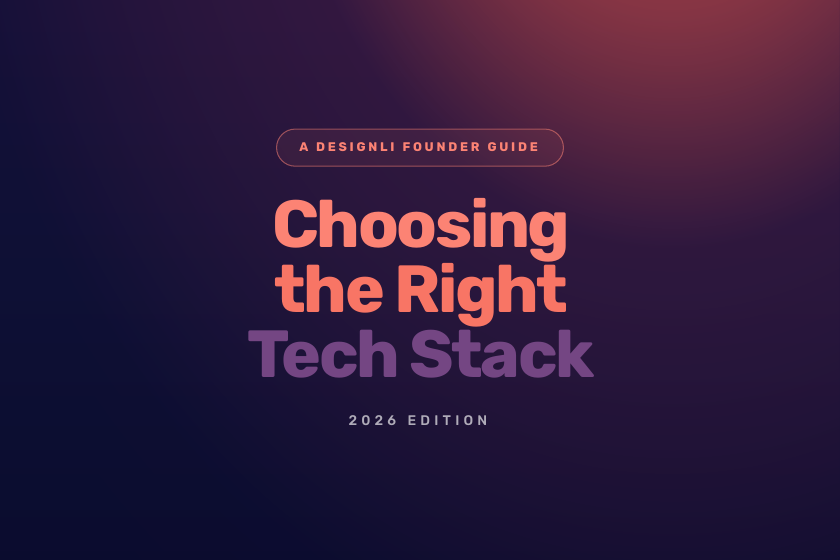
Designli's free Tech Stack Guide for founders. Learn how to choose frontend, backend, database, and infrastructure that fit your product, budget, and team.
 1 min read
Learn how SaaS founders use Hypothesis-Driven Development (HDD) to reduce risk, validate features fast and reach product-market fit.
Talk through your product, customers or growth with the mentor you've seen in Designli Academy.