
The Moat Report: How SaaS Founders Are Building Defensibility in 2026
2026 Designli Survey Report: How 100 SaaS founders are building technical, data, service, and distribution moats, and how AI is reshaping every one of them.
Written by Keith Shields, Jul 13, 2026

To understand how SaaS founders are competing today, you have to start with a problem that didn't exist five years ago at this scale: building software is now cheap, fast, and increasingly accessible. AI has lowered the floor. Features that once took six months to ship can be replicated in weeks, even days. The time between "we built this" and "so did everyone else" is shrinking fast.
Which raises the most important question a founder can ask in 2026: How are SaaS founders building moats that compound across technology, data, service, and distribution?
That's the question this report is built around. We surveyed SaaS founders across industries to understand how they think about defensibility, where they're investing, and where the gaps are. The answers point to a common pattern: moat-building is happening, but it's more reactive than designed.
What a Moat Actually Means
A moat, in the SaaS context, is any structural advantage that makes it harder for a competitor to displace you over time. It's the gap between what you've built and what a well-resourced competitor would need to do to replicate your features and position.
A strong moat becomes stronger the longer it runs, while a weak one gets exposed the moment a better-funded alternative enters the market.
In 2026, the combination of AI tooling, open-source models, and abundant engineering talent means the cost of building features has dropped significantly. That's good news for builders and also for copycats. Which is why moat thinking matters more now than it did when the barrier to entry was simply the ability to ship software at all.
This report covers four moat dimensions: technical, data, service and retention, and distribution. We treat them as a system, and the strongest founders are building across all four.
AI as Both Moat-Builder and Moat-Flattener
Before diving into the findings, it's worth establishing something the data confirmed clearly: AI is not inherently a moat. It can build one or flatten one, depending entirely on how it's used.
-
Strategic AI Integration: When used to lock in proprietary data loops, automate specific workflows, or compound institutional knowledge, AI accelerates long-term business defensibility.
-
Reactive AI Integration: When deployed defensively, like slapping on features just because competitors did it or wrapping a general-purpose model in a thin interface, AI becomes a liability that barely looks like a feature.
Anyone can wrap an off-the-shelf LLM. True market value comes from building the specific proprietary context that makes the tool meaningfully better for a specific user and use case.
Who Answered This Survey
Our respondents were founders and operators actively building or scaling SaaS products. The group included technical founders with engineering and product backgrounds, non-technical founders from business, sales, and operations, and hybrid profiles who sit between the two. Industries represented include AI and automation, martech, cybersecurity, the future of work, retail and hospitality, fintech, and edtech.
One finding worth noting upfront: how a founder defines their moat is shaped heavily by their background. Technical founders default to architecture, infrastructure, and proprietary models. Non-technical founders are just as likely to name brand, relationships, and domain expertise. Both are right, and both perspectives are represented in what follows.
The Technical Moat
Technical moats are the most intuitive kind. They come from building something that's genuinely hard to replicate: a custom model, a proprietary integration, or infrastructure that took years to optimize. But in a landscape where AI has accelerated development across the board, the definition of "hard to replicate" is changing quickly.
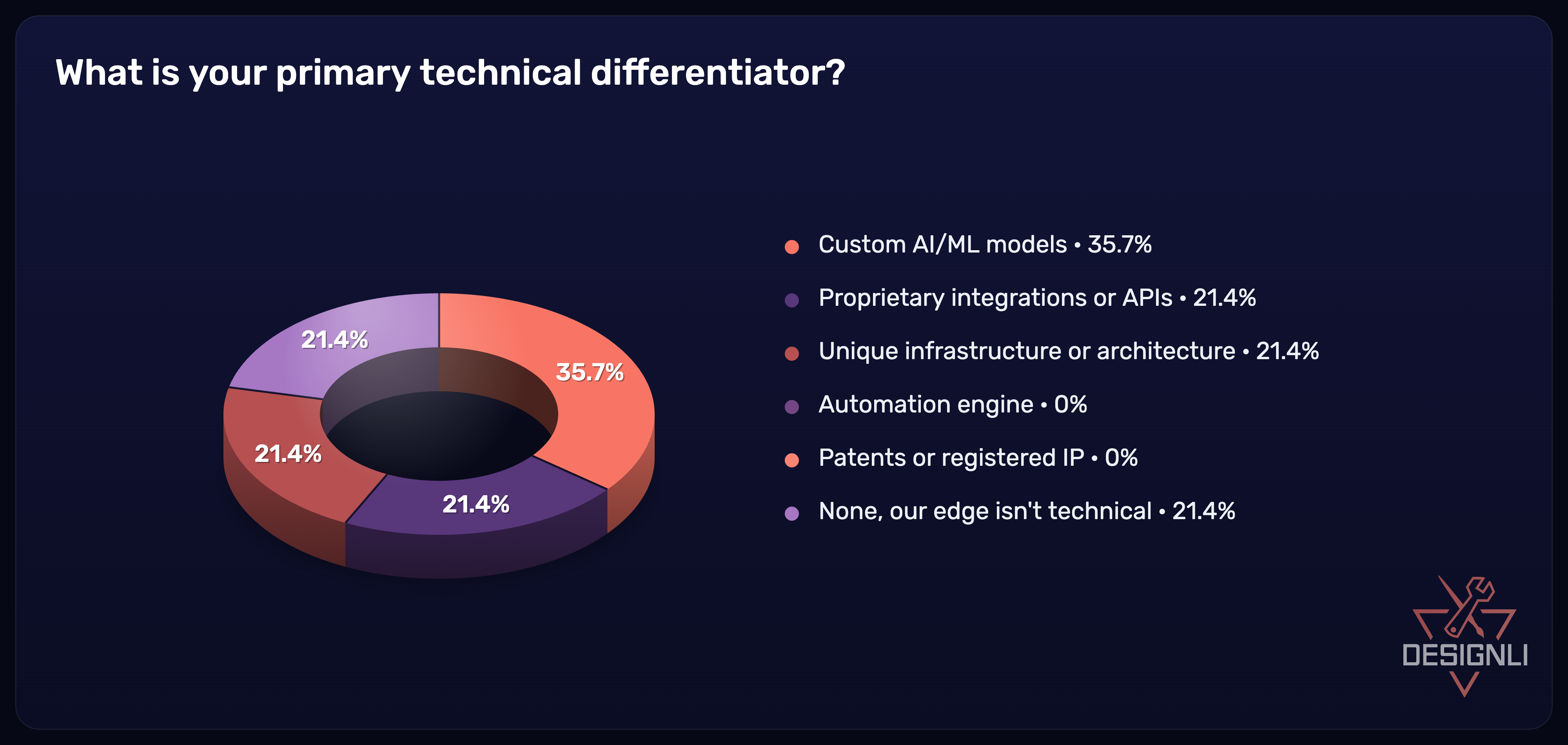
What is your primary technical differentiator?
The most common answer was custom AI or machine learning models, cited by 35.7% of respondents. Proprietary integrations and APIs came in at 21.4%, as did unique infrastructure. But the most telling number was the 21.4% who said their edge isn't technical at all. It's something else entirely.
In a survey where AI and automation founders made up a significant portion of respondents, the fact that one in five explicitly acknowledged their moat isn't technical is worth pausing on. It suggests that even within technically sophisticated teams, competitive advantage is increasingly being located in areas that code alone can't replicate: domain expertise, customer relationships, and brand trust.
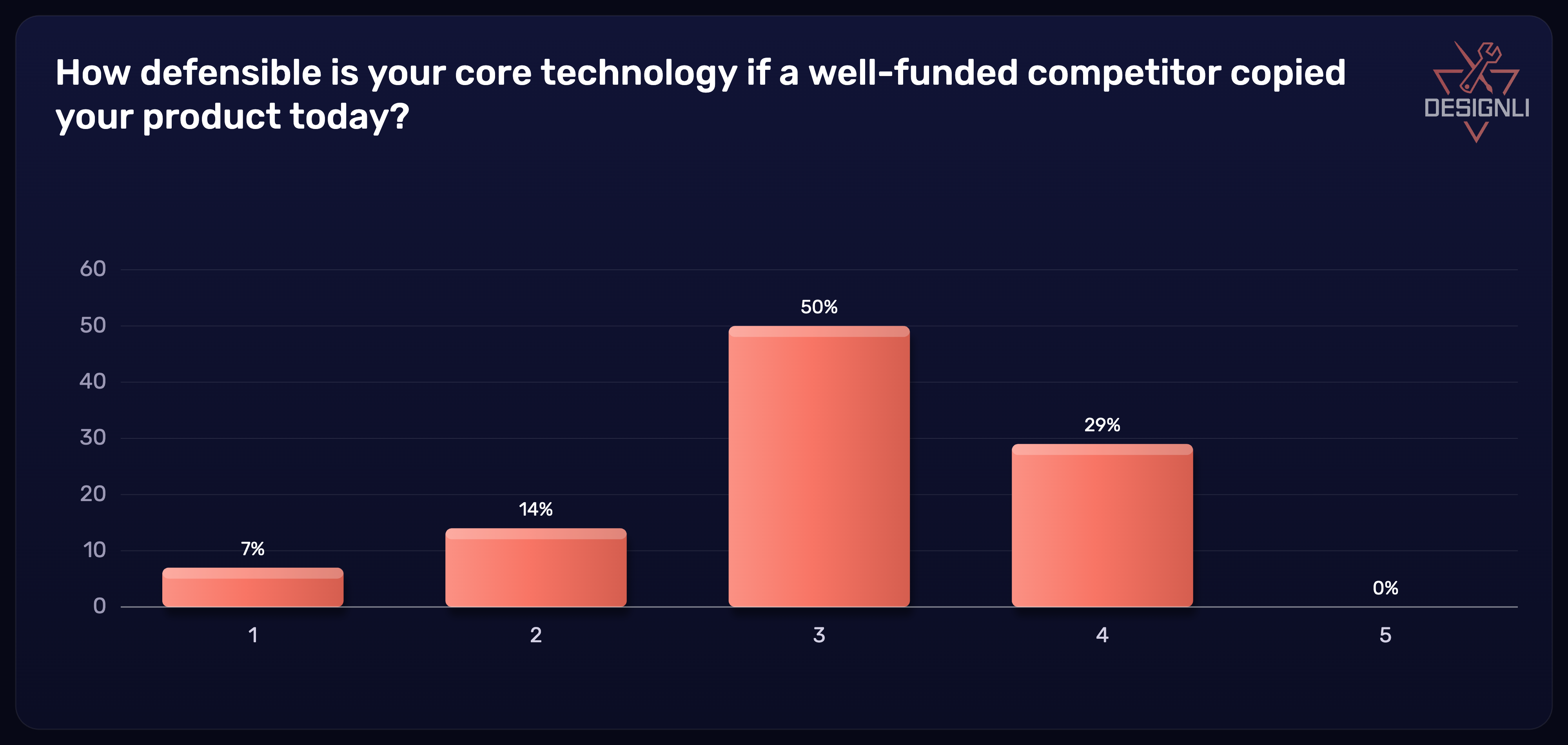
How defensible is your core technology if a well-funded competitor copied your product today?
Founders rated their technology defensibility on a five-point scale. Half rated themselves at 3 out of 5. Another 28.6% gave themselves a 4. Not a single respondent rated themselves a 5.
That's notable. These aren't inexperienced founders; these are builders who know their technology well and are being honest about where it stands. A 3 out of 5 is the acknowledgment that defensibility is an active problem and must be solved.
The more interesting question is whether that self-awareness is translating into strategy. Knowing you're not untouchable only helps if it changes what you build next.
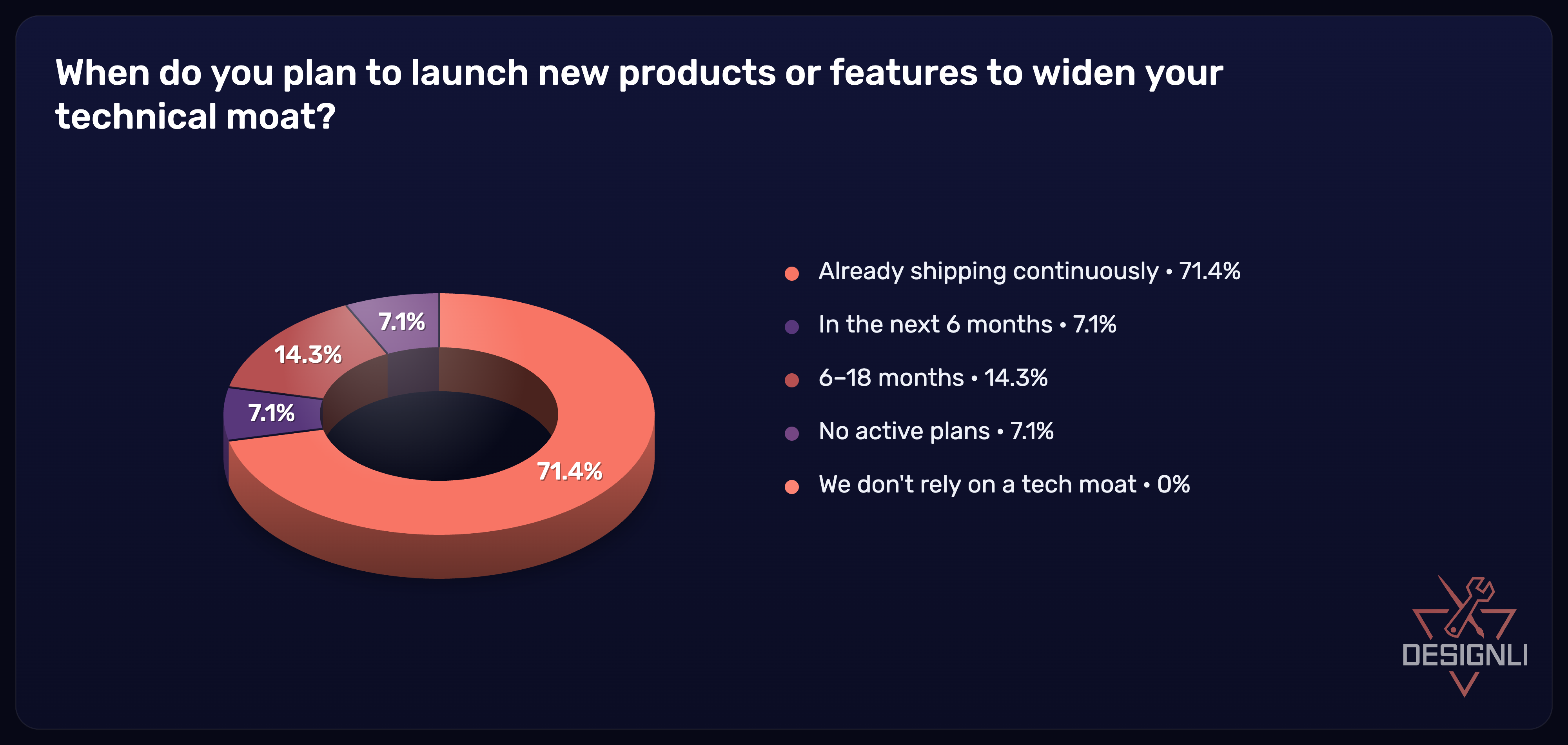
When do you plan to launch new products or features to widen your technical moat?
71.4% of respondents are already shipping continuously with moat-widening as an explicit goal. Another 14.3% plan to within 6 to 18 months. Only 7.1% have no active plans to widen their technical advantage.
Velocity is the default response to defensibility anxiety. But continuous shipping is only a moat if what's being shipped compounds. Features that don't create switching costs or data advantages can be matched just as fast as they're released. The question is whether what you're shipping is building something a competitor would actually need years to replicate.
The founders who are winning on technical defensibility are moving in a direction that gets harder to follow the longer they run.
Key Takeaways
The technical moat data points to three things worth internalizing.
-
No one rated their defensibility a 5 out of 5. That's a level of honesty the industry often lacks, and it only matters if it changes what gets prioritized on the roadmap next.
-
71.4% of founders are continuously shipping to widen their moat, but velocity only compounds when what you're building creates switching costs, accumulates data, or increases workflow dependency. Speed without that direction is just movement.
-
The most honest finding in this section may be the 21.4% who said their edge isn't technical at all. In a field obsessed with models and infrastructure, a meaningful share of founders are betting on things code can't replicate: relationships, domain knowledge, and trust. That's worth taking seriously.
-
For a deeper look at how to design technical defensibility from the first sprint, Designli's 2026 moat guide is worth reading alongside this data. And for a broader framework on what actually protects AI-era products, Y Combinator's moat breakdown offers useful context.
The Data Moat
Of the four moat types, the data moat is the one that takes the longest to build and is most durable once established. It's also the one most founders are underestimating, not in theory, but in practice.
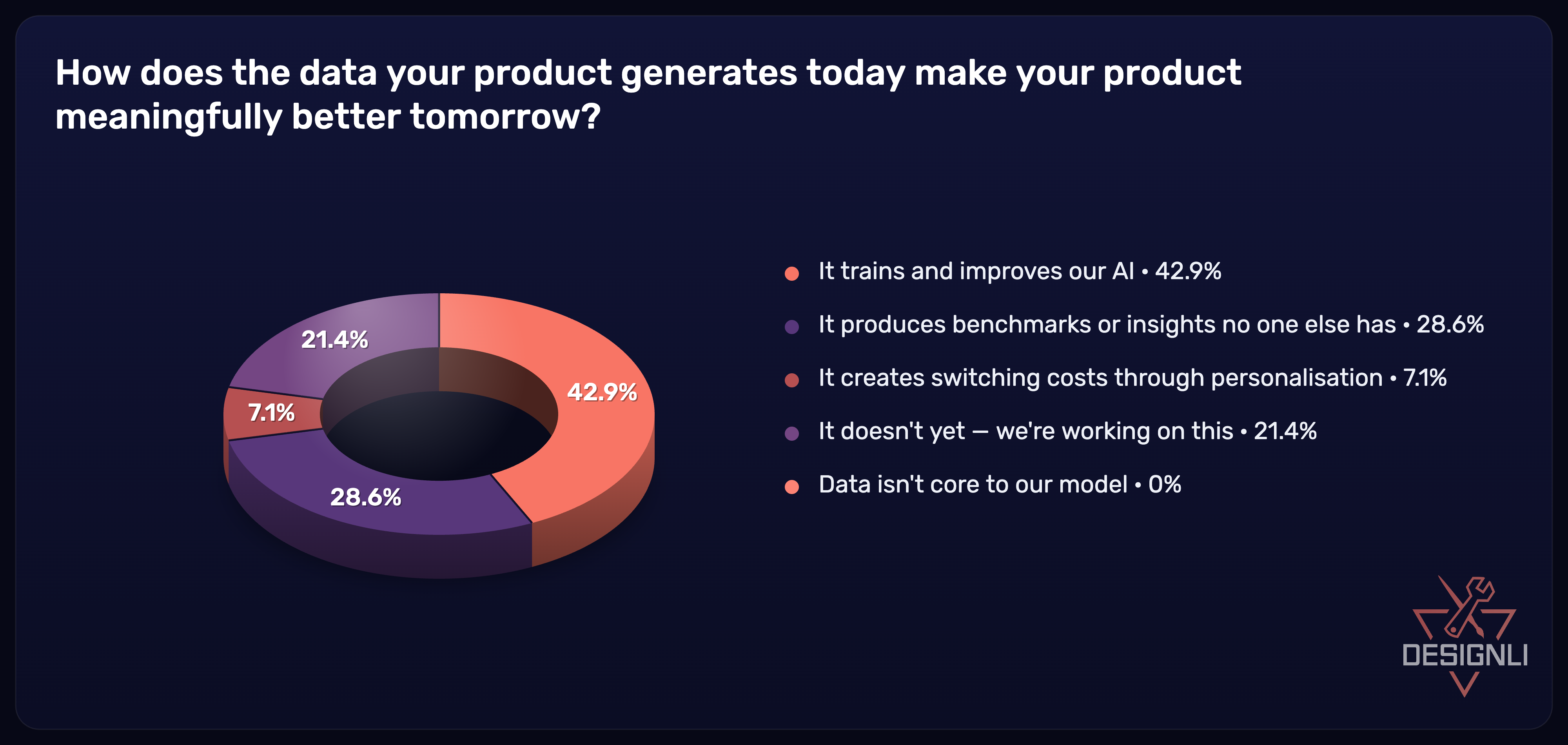
How does the data your product generates today make your product meaningfully better tomorrow?
42.9% of respondents said their product data actively trains and improves their AI; the flywheel is running. Another 28.6% are producing unique benchmarks or insights that no competitor currently has. Both are meaningful data moat foundations.
But here's the gap: 57.1% of respondents have less than 12 months of proprietary data. Only 14.3% have accumulated five or more years.
That gap between "we're collecting data" and "our data is irreplaceable" is where most products currently sit. A data flywheel that's been running for eight months is just the beginning of a moat. The moat emerges when the accumulated data becomes so domain-specific, so longitudinal, and so tied to real outcomes that replicating it would take a competitor a lot of time and resources.
What data asset are you building today that will be impossible to replicate in 1 year?
The range of answers here was striking. On one end: a founder building a proprietary dataset mapping how US companies search for talent, combining SEO signals, marketplace performance, candidate profiles, and client feedback into something no one else has or could quickly assemble.
On the other end, "our own database," "domain knowledge," and "customer behavior" responses are so general they could describe almost any SaaS product.
The difference matters. The founders with the clearest data moat strategy can describe exactly what they're building, why it's specific to them, and why time is on their side. Vague answers are a clear sign that your data strategy is not yet intentional. Instead of being a deliberate architectural decision, your data is simply a random byproduct of daily operations.
If you can describe your data moat in a single concrete sentence, covering what it is, who generates it, and why it gets more valuable over time, you probably have one. If you need three paragraphs and still end up with something general, the moat is still in the concept phase.
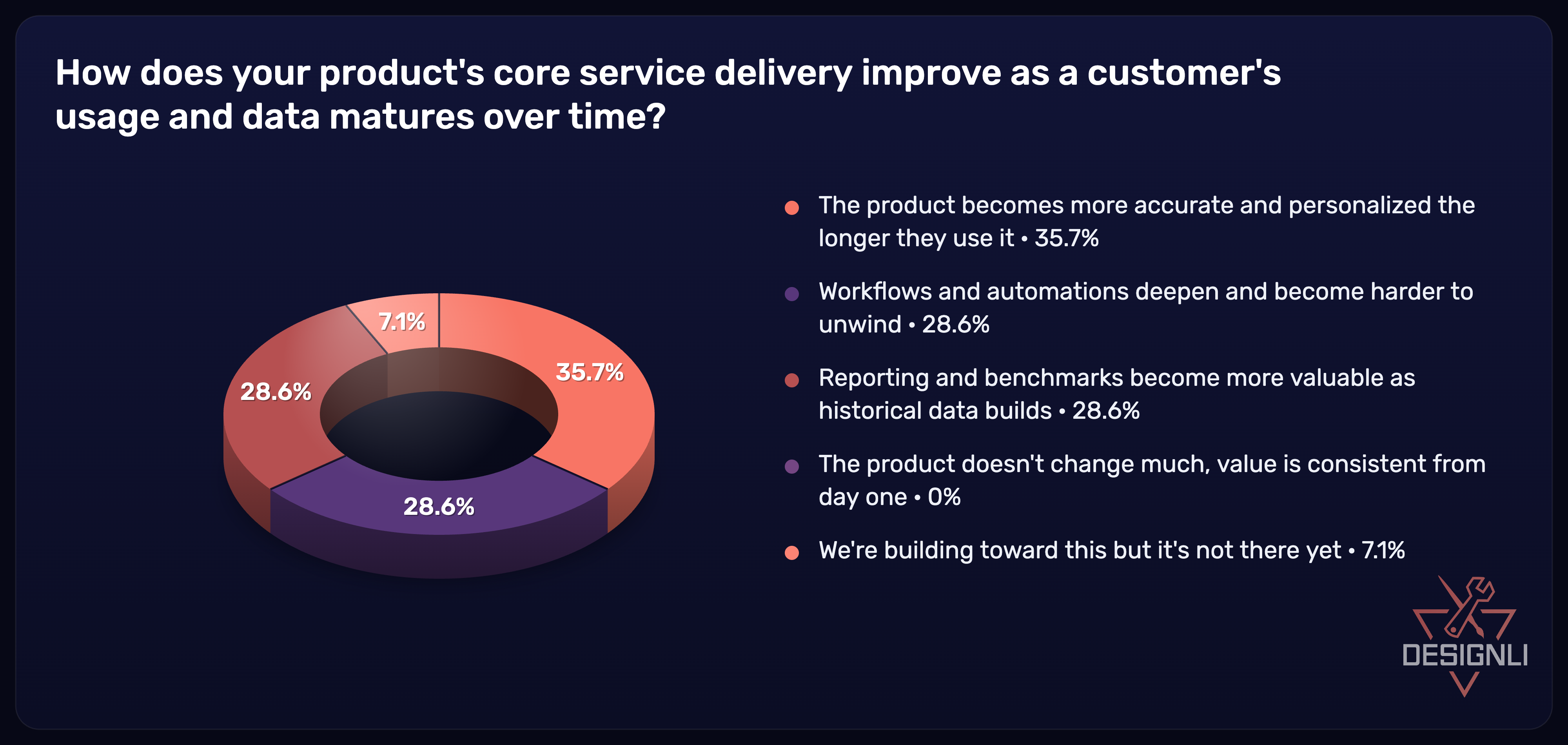
How does your product's core service delivery improve as a customer's usage and data mature over time?
Founders described three distinct compounding mechanisms, and the split was nearly even across all three.
- 35.7% said the product becomes more accurate and personalized the longer a customer uses it.
- 28.6% described workflows and automations that deepen over time and become difficult to unwind.
- Another 28.6% pointed to reporting and benchmarks that grow more valuable as historical data accumulates.
No single compounding mechanism dominated, which suggests that data moat design is still being figured out in real time across the industry, rather than converging on a proven model, a clear reflection of the market's current stage. But it does mean the founders who get intentional about this early will have a meaningful advantage over those who discover it later.
Key Takeaways
The data section surfaces a gap that most teams recognize intellectually but haven't fully closed in practice.
-
The flywheel is running for many. 42.9% are actively training their AI on product data, and 28.6% are generating benchmarks no competitor can replicate. That's real progress. But 57.1% have less than 12 months of proprietary data, which means most teams are still in the accumulation phase, not the defensibility phase. Those are two very different places to be.
-
The clearest signal of whether a founder has a real data moat strategy is how specifically they can describe it. A concrete, one-sentence answer points to intentional architecture. A vague one points to data that's accumulating as a side effect, not as a designed asset.
-
The three compounding mechanisms founders described, personalization, workflow depth, and historical reporting, splitting almost evenly across the respondent group, are themselves worth noting. There's no consensus yet on the right model, which means the advantage goes to whoever gets deliberate about it first.
-
For founders still figuring out how to turn product data into a compounding AI advantage, this practical AI integration guide covers the starting points. On the flywheel concept specifically, this data moat explainer is a clean reference for understanding how the loop works.
The Service and Retention Moat
Technical and data moats are built inside the product. The service moat is built in the relationship. It's the accumulated trust, workflow depth, and switching cost that come from how embedded it becomes in the way your customers operate.
In a market where AI can increasingly match feature parity fast, service has moved from a support function to a strategic one.
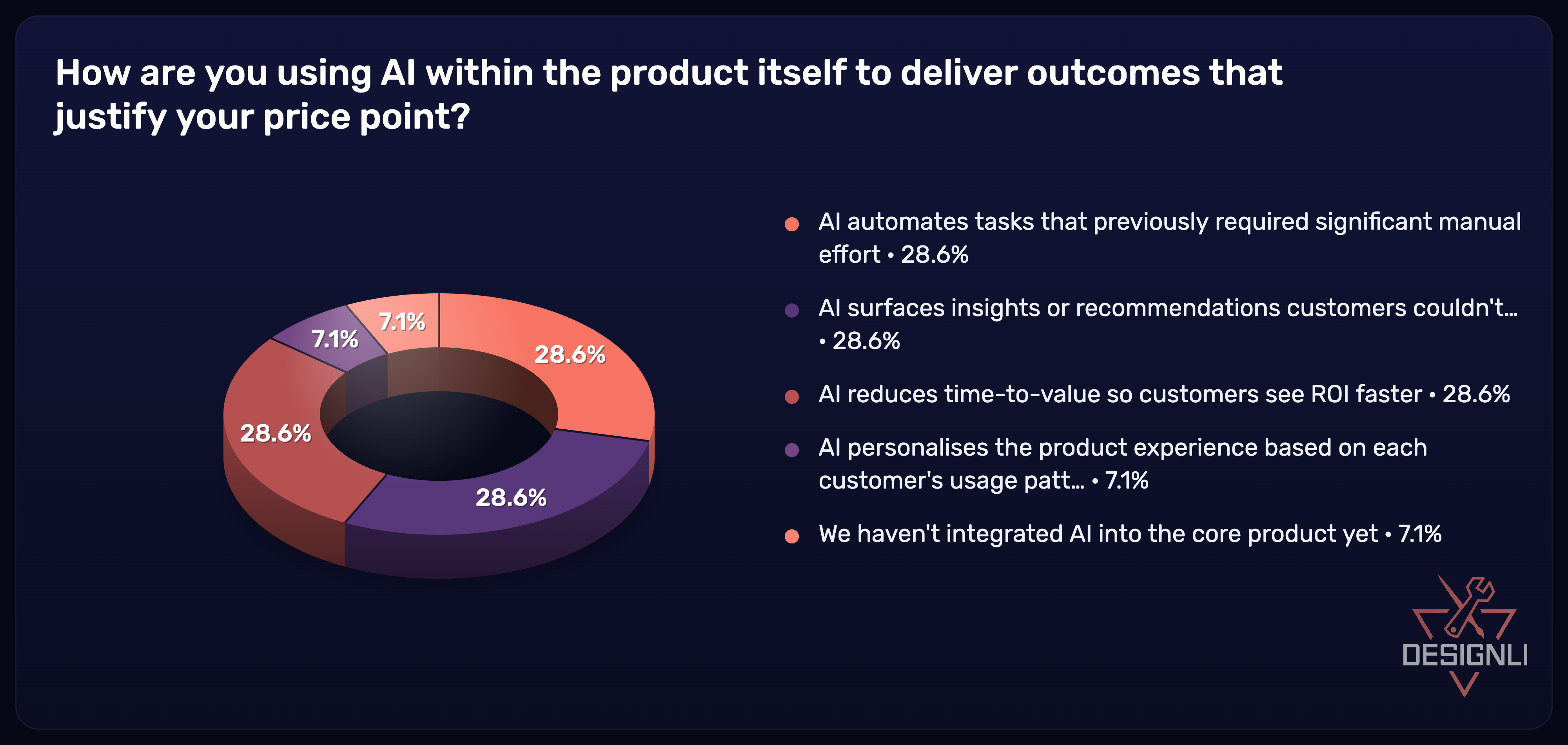
How are you using AI within the product itself to deliver outcomes that justify your price point?
When asked about value propositions, respondents split exactly down the middle across three core buckets: automating manual tasks, surfacing hidden insights, and reducing time-to-value. Each of these three categories captured 28.6% of the total vote. Meanwhile, a tiny minority, just 7.1%, stated they have not yet integrated AI into their core product experience.
The absence of a single dominant AI value proposition is itself meaningful. Founders are finding different ROI entry points depending on their product type and customer profile. There is no universal blueprint for pricing AI. The most sustainable way to justify a premium rate is to tie your price directly to the specific workflow the tool improves.
Generic AI claims like "it saves you time" are easily copied by competitors. True value comes from specificity: proving a tool cuts an operations team's manual reconciliation from four hours to twenty minutes using their own historical data. That specificity is your business moat.
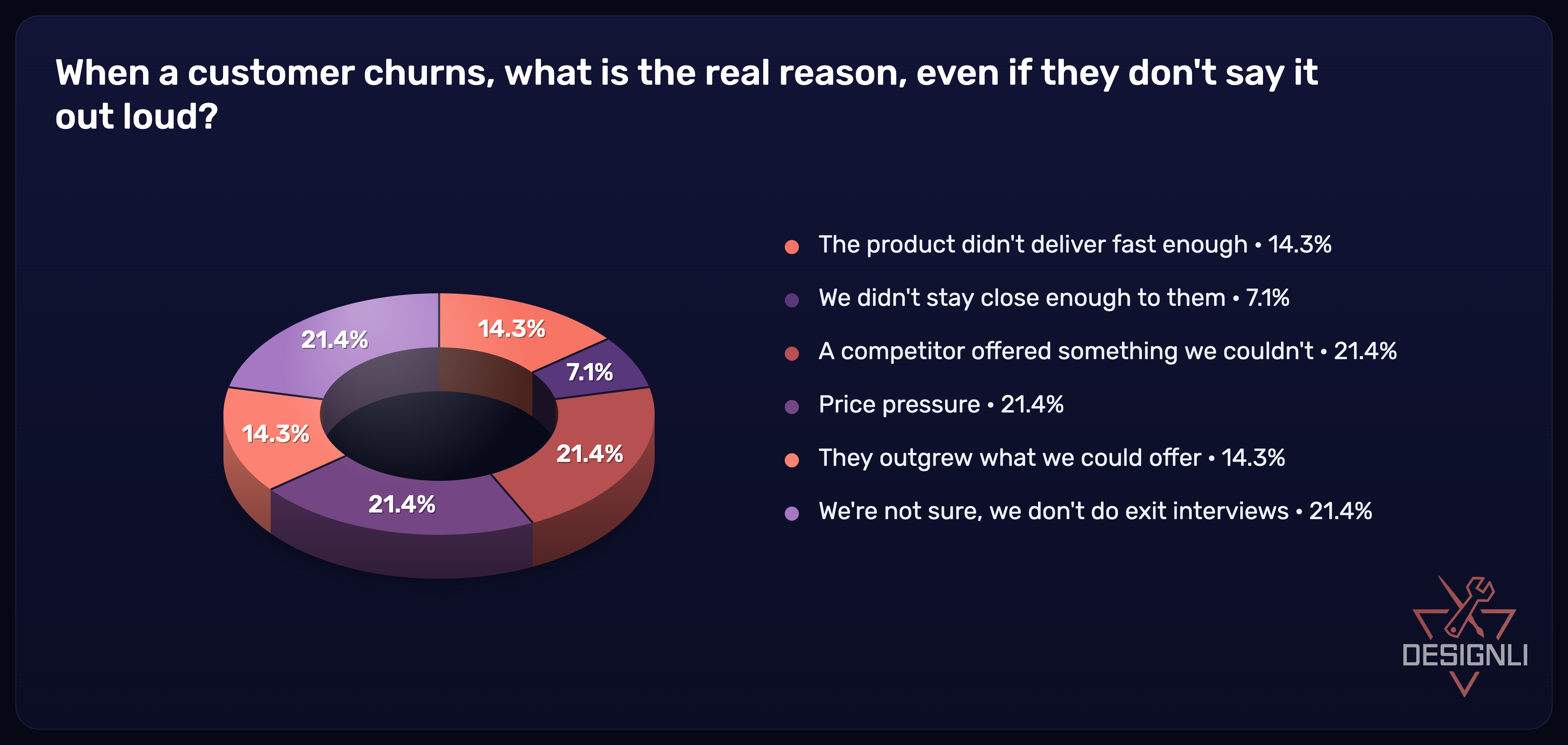
When a customer churns, what is the real reason, even if they don't say it out loud?
Churn attribution was fragmented. Four near-equal reasons emerged: a competitor offered something the customer couldn't get from the current product (21.4%), price pressure (21.4%), the product didn't deliver value fast enough (14.3%), and the customer outgrew the product (14.3%).
The most concerning number: 21.4% of respondents said they don't conduct exit interviews at all and genuinely don't know why customers leave.
You cannot build a service moat if you don't understand where it's breaking down. Fragmented churn attribution leads to a weak retention strategy; teams patch the most visible problems without addressing the underlying ones. Understanding why customers leave is one of the highest-leverage activities in a SaaS business, and one in five founders has deprioritized it.
How often do you ship custom features specifically requested by individual high-ticket clients?
Responses ranged across the full spectrum: weekly, monthly, and almost never. Some teams have dedicated in-house developers allocated specifically to enterprise customization. Others don't do it at all.
That range reflects a genuine strategic tension. Custom feature development for high-ticket clients increases switching costs and can anchor enterprise retention in ways that standard product roadmaps can't. But done without discipline, it fragments the core product, creates technical debt, and pulls roadmap focus away from the improvements that serve the broader customer base.
The founders who do this well treat it as an intentional part of their service architecture, with clear criteria for when customization is necessary and what gets absorbed into the core product versus maintained as a client-specific build. The ones who struggle with it tend to do it in response to client pressure rather than as part of a retention strategy.
Key Takeaways
The service moat is the least visible of the four and, in many ways, the most vulnerable to neglect.
-
The even three-way split across AI value propositions tells you something useful: there's no single answer to "how does AI justify your price." The right answer is specific to your product and your customer. The teams building durable service moats have figured out exactly which workflow they own and what it costs the customer to lose it.
-
One in five founders has no idea why their customers leave. That number should be higher on everyone's priority list. Exit interviews aren't a nice-to-have; they're the fastest feedback loop available to a retention strategy. A service moat built on assumptions is built on sand.
-
The custom feature shipping question revealed the deepest strategic tension in this section. Done with clear criteria, it deepens enterprise retention and creates switching costs that compound over time. Done reactively, it quietly fragments the product and inflates technical debt. The difference between the two is almost always whether there's a framework in place before the client asks.
-
For a broader look at why users leave and what to do about it, Designli's retention guide connects the service moat story to practical levers. For benchmarks on what healthy churn looks like across the industry, this 2026 churn breakdown gives useful numbers to compare against.
The Distribution Moat
Distribution is the moat that doesn't show up on a product roadmap and rarely appears in a technical architecture diagram. But it may be the most durable of the four. A strong distribution moat means you reach customers in ways your competitors can't easily replicate: through owned audiences, deep channel relationships, or discovery mechanisms that took years to build.
In 2026, the distribution landscape is being rewritten by AI-driven search and discovery. Founders are paying attention.
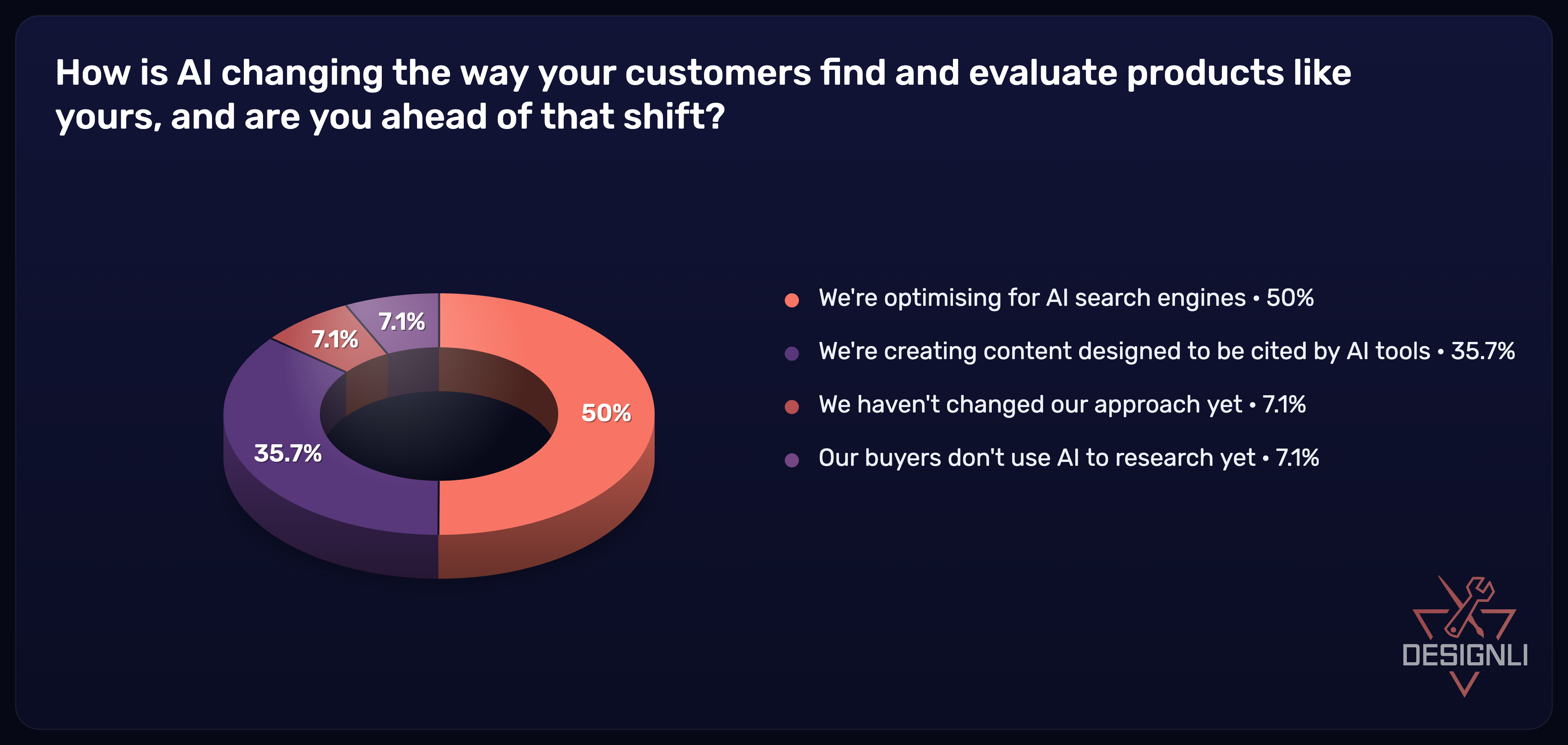
How is AI changing the way your customers find and evaluate products like yours, and are you ahead of that shift?
50% of respondents are actively optimizing for AI search engines. 35.7% are creating content specifically designed to be cited by AI tools like ChatGPT, Claude, and Perplexity. Only 7.1% said they haven't changed their approach yet.
That means 85.7% of respondents are already treating AI discoverability as a distribution priority. This is meaningfully ahead of where most published research suggests the broader market is. These founders see the channel shift happening in their own acquisition data and are moving into it.
The implications for moat-building are significant. Traditional SEO took years to compound into a distribution advantage. AI search optimization is newer, and the rules are still forming. The founders who develop strong positioning in AI-cited results early will have a head start that's difficult to catch.
If your primary acquisition platform changed its algorithm or terms tomorrow, what percentage of your lead flow would vanish?
35.7% rated their platform vulnerability at 2 out of 5, moderately exposed. Another 35.7% rated it at 4 out of 5, highly exposed. Roughly 7% of respondents rated themselves at maximum vulnerability.
The spread tells the real story. Some founders have meaningfully diversified their acquisition channels, reducing dependence on any single platform. But the majority are still one algorithm change, one policy update, or one pricing shift away from a significant disruption in lead flow. No one has fully solved owned distribution.
This is the distribution moat's central challenge: building it requires time and consistency, and most early-stage SaaS businesses are rightly focused on what works now rather than on owned channels that take 18 months to pay off. But the founders who start building earlier compound the advantage longer.
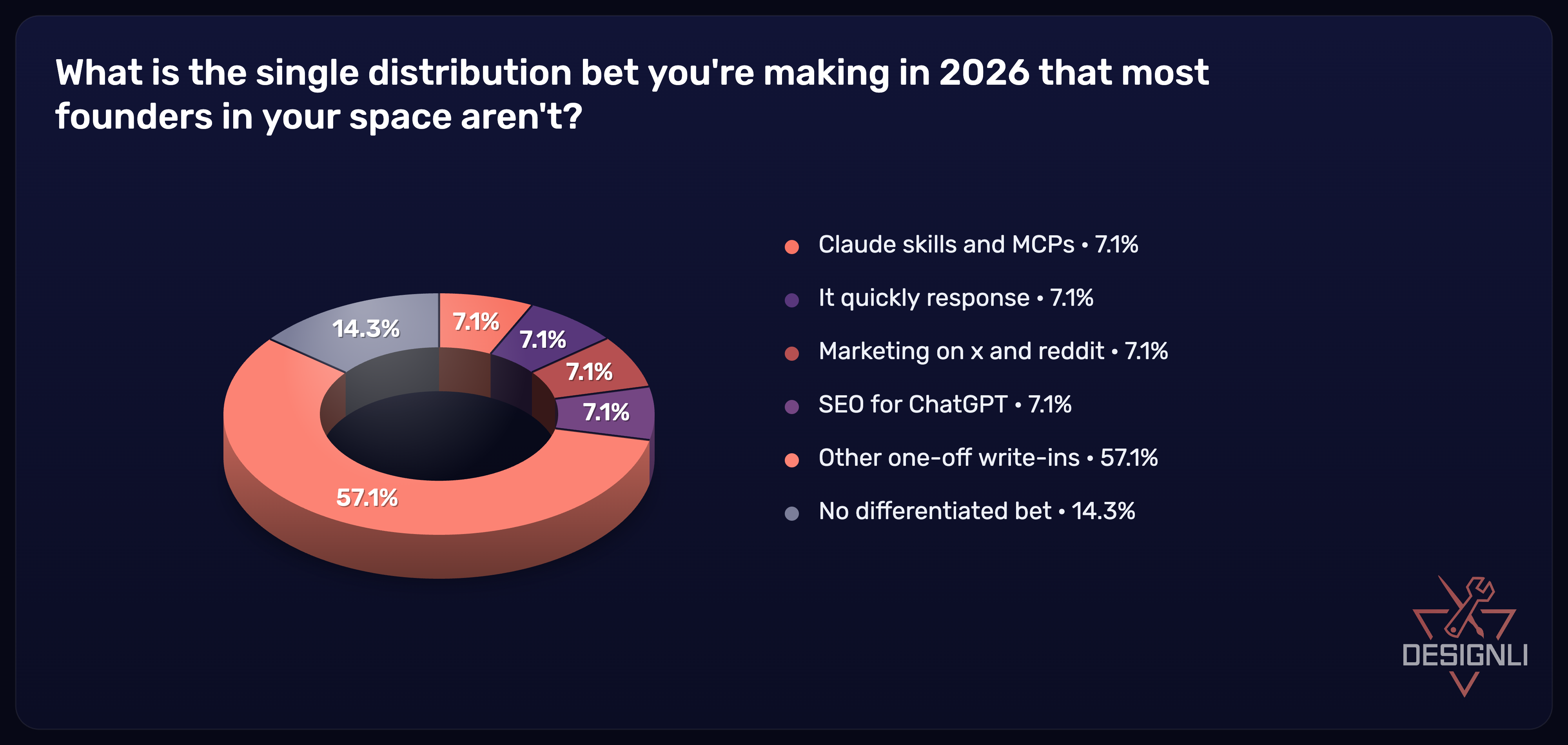
What is the single distribution bet you're making in 2026 that most founders in your space aren't?
Respondents cited four distinct, high-conviction plays:
-
AI Search Optimization: Tailoring content specifically to rank well within ChatGPT and AI discovery results.
-
Community-Led Growth: Building a direct presence and driving organic acquisition on X and Reddit.
-
The API & Model Channel: Developing custom Claude skills and Model Context Protocol (MCP) integrations to serve as an unconventional discovery engine.
-
Rapid-Response Content: Deploying agile content mechanics designed to hijack attention and ride the wave of breaking industry news.
Roughly 14% of respondents stated they were not placing a single, differentiated distribution bet either because their efforts are entirely diversified across standard channels or because they simply have not approached strategy at this level yet.
The absence of a consensus bet is itself the signal. In previous years, there was a playbook: content marketing, paid social, and SEO. In 2026, the playbook is being rewritten in real time. There's no established channel that every founder is piling into, which means the founders making early, specific bets on emerging channels have a genuine opportunity to build a distribution moat before the crowd arrives.
Key Takeaways
The distribution data may be the most forward-looking in this entire report.
-
85.7% of respondents are already treating AI discoverability as a priority. This reflects a shift already underway in how these founders are allocating attention and resources. The window to build early positioning in AI-cited results is open, but it won't stay that way.
-
Platform dependency is the unresolved problem underneath the surface of every distribution strategy. The fact that zero respondents said they'd lose nothing if their primary platform changed overnight is a clear signal. Diversification is understood as a goal; very few have actually achieved it. Owned distribution takes 18 months to compound, which is exactly why most teams keep postponing it.
-
The four distribution bets founders described, AI search optimization, community-led growth, API and MCP integrations, and rapid-response content sharing, have one thing in common: none of them are the old playbook. That's the real finding. The founders placing differentiated bets now are not following a proven path. They're building the path.
-
For founders still building toward their first reliable acquisition channel, Designli's first 100 users guide is a practical starting point. And for a tactical framework on optimizing for AI search, this 2025 GEO playbook breaks it down in concrete steps.
Designli's Stance
Across four moat dimensions and the survey questions, one pattern emerged more clearly than any single data point: founders are building moats reactively, not by design.
-
They're shipping continuously, but not always compounding.
-
They're collecting data but not always with a clear sense of what makes it irreplaceable.
-
They're using AI to justify price, but not always measuring whether that justification is landing.
-
They're adapting to AI-driven discovery, but without a clear owned channel to fall back on if that shift accelerates faster than expected.
It reflects the reality of building in 2026, where the pace of change makes deliberate long-term strategy feel like a luxury. But the founders who pull ahead are the ones who move with the clearest sense of where they're going and why it compounds.
A moat is most powerful when it's defined before the build, not modified after the product is already in the market. That means asking early and explicitly: What is the structural advantage we're designing for, and how does every product decision either reinforce it or undermine it?
That's the work most teams haven't fully done yet. And it's the gap this report is meant to surface.
If you're a founder who has shipped the product but hasn't yet named your moat, or who suspects the moat you're building isn't as durable as it needs to be, the right step is to develop a clear-eyed diagnostic of where your defensibility actually sits and make a deliberate decision about where to invest next.
Pressure-test your moat before your next build cycle. That's the conversation Designli's Impact Week is designed to start: a $1,700, one-week focused engagement where founders pressure-test their positioning, their product strategy, and their moat assumptions before committing to the next phase of the build. For teams ready to move into execution, the Custom 90-Day Plan translates moat decisions into a sprint-by-sprint roadmap from day one.
Methodology
This report draws on a structured survey administered across SaaS founders and operators at industry conferences, founder communities, and professional networks. The survey combined quantitative inputs, multiple-choice questions, and rating scales with qualitative open-text responses, allowing us to capture the reasoning behind those responses.
Respondents represented a cross-section of technical, non-technical, and hybrid founder profiles, ensuring the findings reflect both product-oriented and business-oriented perspectives. Industries represented include AI and automation, martech, cybersecurity, future of work, retail and hospitality, fintech, and edtech. In total, 100 SaaS founders and operators completed the survey.
As with any founder survey, responses reflect the perspectives of individuals actively building, with strong opinions, genuine uncertainty, and real stakes in the questions asked.
Why Your Moat Is More Important Than Ever in 2026
The data from this report confirms that SaaS founders in 2026 are actively building, shipping, integrating AI, and adapting to new discovery channels. Even though the energy and intent are there, the strategy is less consistent.
Across all four moat dimensions (technical, data, service, and distribution), the same gap appeared, with strategies that are:
- More reactive than intentional
- More parallel than compounding
- More responsive to immediate pressure than oriented toward long-term defensibility
This is the true competitive battlefield in 2026. The race is no longer about building faster or stacking AI features onto a roadmap. The real opportunity lies in closing the gap between what you have already shipped and what is genuinely impossible for someone else to replicate. It is about fixing that structural vulnerability now, before shifting market dynamics force the issue on someone else's terms.
Ultimately, the founders who win are the ones who decide, with absolute deliberation and clarity from day one, exactly what they are building a moat around. Every line of code, every architectural choice, and every operational layer that follows should be designed to do one thing: reinforce that single core defense.
Ready to put this into action?
Grab the resource above, then let's talk about turning your plan into a product.