

Once an idea has been validated, the conversation shifts from what to build to how to build it correctly. At this stage, execution becomes the primary differentiator. For businesses today, where development costs are high and competition moves fast, building efficiently is a necessity.
The reality is that many products fail because execution introduced friction, delays, or unnecessary complexity. Choosing the right development approach, team, and technical foundation determines whether a product reaches the market quickly and with quality or gets stuck in an expensive, prolonged build phase.
This is where experienced product teams create their most tangible value. Building a digital product is about making structured decisions that balance speed, scalability, and long-term maintainability from day one.
From Concept to Execution: Why the Build Phase Is Critical
After validation, there is often a strong impulse to move fast and build everything at once. That urgency is understandable, but unstructured execution can turn momentum into waste.
Rushing results in development inefficiencies that are magnified quickly. Misaligned features, unclear requirements, or poor technical decisions lead to unnecessary spending before a single user ever sees the product.
Effective teams approach development as a controlled, intentional process:
- They prioritize what truly drives user and business value
- They reduce complexity to what is essential at each stage
- They build in a way that supports continuous iteration without constant rework
Designing User Experiences That Convert
For a product to succeed, users must understand it quickly and act on it naturally.
User experience (UX) is where many products either gain traction or lose users entirely, often within the first 30 seconds of interaction. A well-designed interface removes friction and guides users toward key actions: signing up, booking a service, and completing a purchase.
In practice, this means:
- Clear user flows: Streamlined pathways over feature-heavy interfaces that overwhelm rather than guide.
- Fast, intuitive interactions: Eliminate complex navigation that requires users to think too hard.
- Design decisions anchored to business outcomes: Target specific metrics like conversion, retention, and long-term engagement.
Users interact daily with products built by world-class design teams at companies like Apple, Stripe, and Airbnb. Anything below that standard creates an immediate drop-off. This is why design should be treated as a strategic component of the product, built in from the first wireframe.
Choosing the Right Technology Without Overengineering
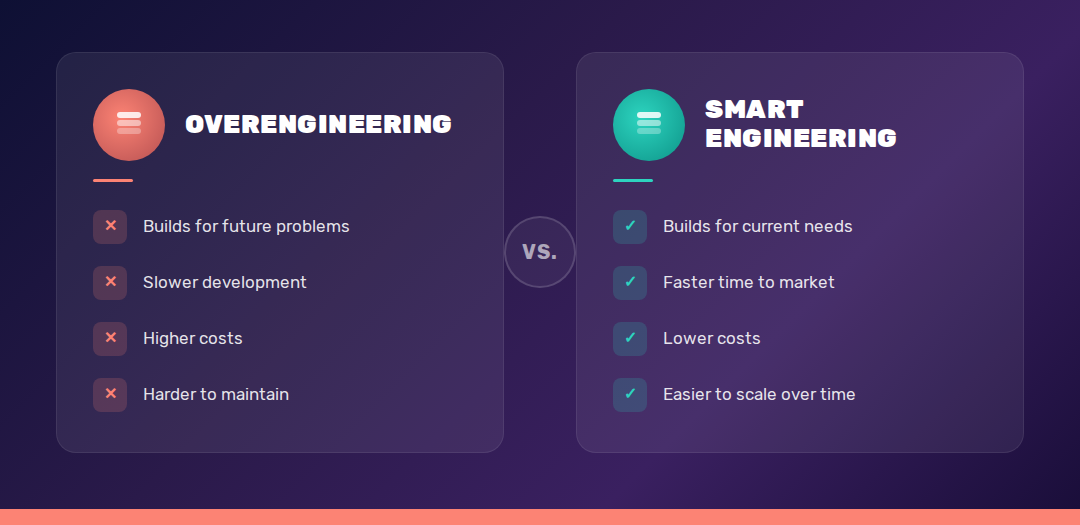
One of the most common and costly mistakes in early-stage product development is overengineering: building systems far more complex than the current stage of the product requires.
While scalability matters, premature optimization slows development, increases cost, and delivers no immediate value to users. A startup that spends three months building a distributed microservices architecture before acquiring its first hundred users has optimized for problems it does not yet have.
Experienced teams take a fundamentally different approach:
- Select proven technologies: Focus on tech stacks that enable fast iteration and have strong developer community support.
- Prioritize core stability: Value long-term maintainability over chasing short-lived framework trends.
- Build scalable, evolutionary systems: Design for progressive growth rather than trying to predict every future requirement on day one.
A well-chosen, appropriately scoped tech stack reduces development time, simplifies long-term maintenance, and allows the team to adapt as the product and its users reveal what actually needs to scale.
Building a Backend That Supports Growth
Behind every successful digital product is a backend system that manages logic, data, and integrations. Users never see it directly, but its quality determines how reliable, performant, and scalable the product becomes as it grows.
A strong backend architecture is built around a few core principles:
- Clean architectural separation: Maintain a clear structure and separation of responsibilities so that changes in one area do not cascade into unexpected problems elsewhere.
- Efficient data modeling: Design database structures for today's features and for the features that are likely to follow.
- Flexible integration capabilities: Build open systems that easily connect with payment platforms, analytics tools, CRMs, and the growing ecosystem of third-party services that modern products depend on.
Rather than building overly complex systems from the start, effective teams design architectures that can expand progressively. This approach avoids the costly and time-consuming rewrites that happen when early shortcuts cannot support later growth.
API-Driven Development for Modern Products
Today's digital products rarely operate in isolation. They interact with payment processors, communication platforms, analytics pipelines, marketing tools, and more.
An API-driven approach enables products to:
- Streamline third-party integrations: Connect seamlessly with the external payment systems, analytics tools, and CRMs that power modern business ecosystems.
- Support multi-surface distribution: Serve web applications, mobile apps, and external client platforms simultaneously from a single, consistent backend.
- Scale functionality incrementally: Expand system capabilities step-by-step without requiring a complete architectural overhaul every time a new integration is introduced.
Instead of being locked into a single implementation, the product becomes a platform, one that can evolve with changing business needs, new partnerships, and expanding user demands.
Security as a Business Requirement
Users today are aware of data privacy. A product that handles personal information, payment data, or business-sensitive content must meet baseline security standards from the moment it goes live. Failing to do so damages trust, reduces adoption, and can expose the business to significant legal and financial risk.
Security foundations require the following:
- Secure access control: Implement strict authentication mechanisms so that only authorized users can access specific, designated data.
- Protection of sensitive information: Ensure all critical data is thoroughly encrypted and secured both at rest and in transit.
- Isolated cross-system communication: Guarantee safe data transfer between internal architectures and external environments, especially when handling private user information.
Retrofitting security into an existing product is always more expensive and disruptive than building it in early. Done right, it is invisible to users and essential to the business.
Efficient Development Through Agile Execution
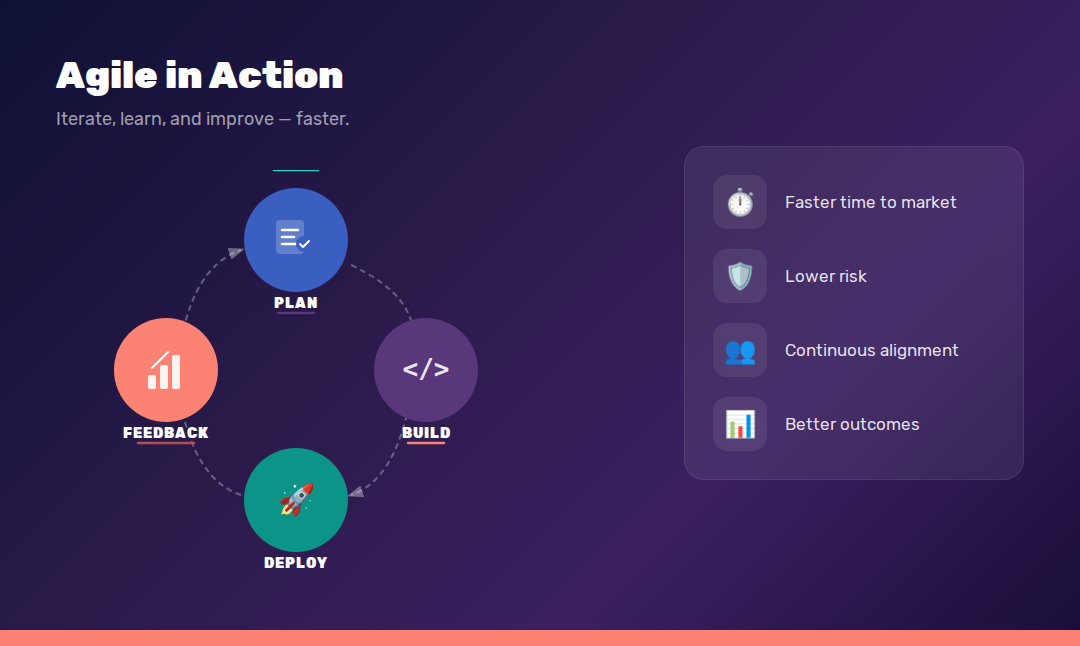
High-performing teams manage this through iterative development. Rather than attempting to build a complete product in a single extended cycle, they work in short, focused sprints delivering incremental improvements, validating assumptions with real users, and continuously refining the product based on what they learn.
This approach delivers several benefits:
- Accelerate market delivery: Get a functional product to users quickly to generate real-world feedback before committing more capital.
- Minimize financial risk: Catch potential problems early while they are still small, isolated, and cheap to fix.
- Maintain strategic alignment: Keep stakeholders closely aligned on progress so the team can pivot smoothly without rewriting the entire roadmap.
Working this way, clients find that progress is visible, decisions are traceable, and the product evolves in direct alignment with business goals.
Continuous Integration and Deployment
One of the defining characteristics of high-performing development teams is how they ship. Modern teams automate the pipeline from code to production:
- Automated testing: Catch and isolate bugs early in the pipeline before they ever impact the user experience.
- Continuous integration: Ensure all new code additions merge cleanly with the existing system codebase.
- Automated deployment: Ship new features and critical hotfixes instantly, reliably, and with minimal operational risk.
For businesses, the result is reliability and speed, two factors that directly impact competitiveness. Products that can ship improvements weekly outpace products that release quarterly. And products that catch bugs automatically before deployment protect the user experience that drives retention.
Reducing Cost Without Sacrificing Quality
Development cost is one of the most pressing concerns in product development, determined by both hourly rates and efficiency.
A poorly scoped project with a high-cost team will consistently be more expensive than a well-structured project with a globally distributed team that operates with discipline and clarity.
The factors that actually drive development cost are:
- Scope clarity: Eliminate ambiguity upfront to prevent expensive, time-consuming rework down the line.
- Technical debt management: Avoid early architectural shortcuts that create compounding engineering costs later.
- Team execution: Deploy lean, focused teams with clear operational processes to outperform large, uncoordinated groups.
When these three elements are aligned, development becomes predictable and budgets are respected. The product that emerges is one that the business can build on consistently.
Distribution and Validation Within the Same Cycle
As the product approaches launch, validate performance under realistic load conditions rather than just ideal scenarios, keeping the system stable when it matters most. This data lets you continuously refine the critical user flows that ultimately determine whether the platform converts or loses users.
To thrive in today's market, develop a well-structured distribution strategy from Day 1. This means validating your product idea well before it's even in the works, getting feedback from potential customers across communities you've identified, and launching lightweight prototypes to test hypotheses.
Validation and distribution should work together. Treating them as separate phases slows you down and puts the entire production scope at risk.
Designli Approach: Building Products That Hold Up Past the Demo
The build phase is where most early-stage products either compound their early momentum or quietly accumulate the debt that makes scaling painful. The difference almost always comes down to the decisions made in the first few weeks of development.
If the product is already built but running into issues, like slow performance, brittle architecture, security gaps, or low feature conversion, Impact Week is the next step. It's a $1,700 one-week intensive where our senior team audits your codebase across front end, back end, and database; scores it by technical debt, scalability risk, and security exposure, and delivers a custom 90-day plan tied to your most pressing issue.
When the idea is validated and the real question is how to build it right, TractionLab is our 90-day engagement where a dedicated team owns the full stack from day one: clean architecture, thoughtful UX, security built in, and agile delivery cycles that keep the product aligned with what users actually need. The team doesn't just build the product. It owns the path to traction alongside it, with a real user by Day 30 and a first paying customer by Day 90.
Execution Is the Strategy
Building a digital product is where strategy meets execution. It is the stage where validated ideas become scalable solutions or become an expensive lesson.
Getting the planning right always makes the difference. Efficient execution, thoughtful design, and scalable architecture are business requirements for any product that intends to grow. Schedule a consultation.


