

You don’t need to be a developer to choose between a mobile app and a web app; however, you do need to understand the trade-offs.
It’s one of the earliest decisions founders make, and it shapes everything that follows: budget, speed to launch, user acquisition, and long-term scalability. The wrong choice can lead to costly rebuilds, while the right one helps you move faster with less risk.
There’s no universal answer. The right path depends on your product, your users, and what you’re trying to achieve. This guide focuses on the differences that actually matter between app vs. web app so you can make the decision with clarity.
TL;DR: Mobile App vs. Web App Comparison
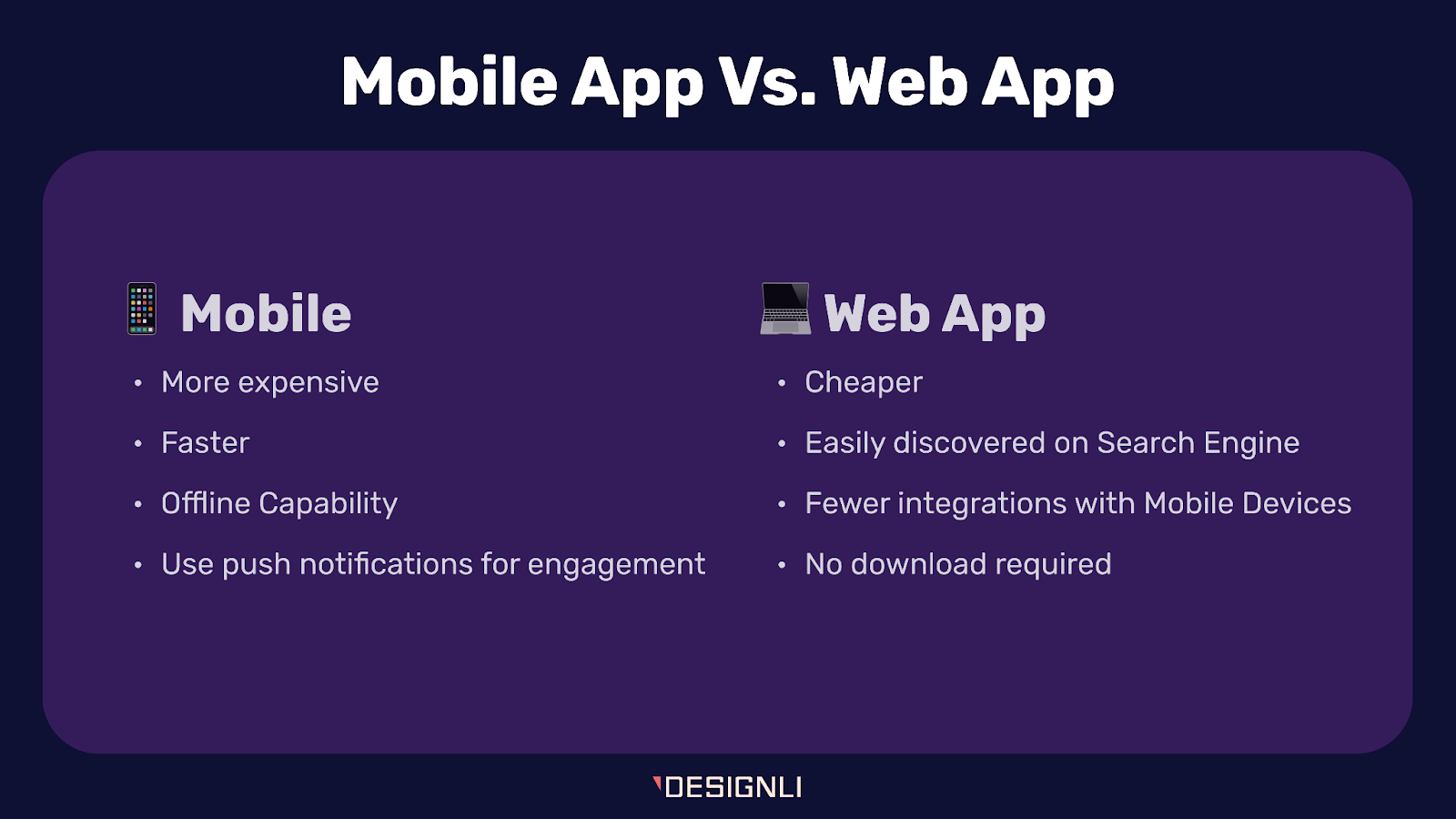
| Factor | Mobile App | Web App |
|---|---|---|
| Cost to build | Higher (iOS + Android or cross-platform) | Lower (single codebase) |
| Speed to market | Slower | Faster |
| Performance | High (native device access) | Moderate (browser-dependent) |
| User Experience | Seamless, device-optimized | Good, but less immersive |
| Discoverability | App Store / Google Play | Search engines (SEO) |
| Offline Access | Yes (in many cases) | Limited or none |
| Monetization | Strong (in-app purchases, subscriptions) | Flexible (subscriptions, SaaS, ads) |
| Updates | Requires app store approval | Instant deployment |
| User acquisition | Harder (download required) | Easier (click-to-access) |
| Best for | Feature-rich, high-engagement apps | MVPs, SaaS, fast validation |
What to Consider When Building a Web App vs. a Mobile App
There are five key factors to consider in your decision-making process, based on your current and future business plans. This decision isn’t just about technology; it shapes how users interact with your product, how fast you can launch, and how you grow.
Start by asking:
-
What features and performance do you need? If your product depends on native capabilities or real-time interactions, a mobile app is often the better fit.
-
What’s your budget and timeline? Mobile apps require more investment and time; web apps are faster and more cost-effective early on.
-
How do your users prefer to engage? If they search online, web is stronger. If they rely on apps daily, mobile may be the better choice.
-
Do you need offline functionality? Mobile apps handle this more reliably.
-
Where will users come from? SEO favors web, while high-engagement and repeat usage often favor mobile.
Mobile App vs Web App
Before comparing pros and cons, it’s important to clearly define what each option actually is in practical, not just technical terms.
Mobile App: It is software installed directly on a user’s device (iOS or Android). It can access native features like the camera, GPS, notifications, and local storage. Examples include apps like Uber, Instagram, or Spotify.
Web App: It is software accessed through a browser (like Chrome or Safari). It doesn’t require installation and works across devices. Examples include tools like Google Docs or Notion (which started as web-first).
Sometimes, like in the case of a Progressive Web Apps, the link can be saved onto the homescreen of a mobile device, so it looks like an app but still opens within a browser when tapped. It saves like a shortcut on a desktop, but with an interface that resembles an app.
Pros and Cons of Building a Mobile App
Mobile apps can be designed for a specific operating system and leverage the native functionality of the mobile device, giving them unique capabilities. Increasingly more common these days is to build mobile apps in cross platform languages, like React and Flutter, allowing one codebase to support an app on both iOS and Android platforms.
Mobile apps are often seen as the “premium” version of a digital product, and in many cases, that’s true. They offer deeper integration, stronger engagement, and a more polished user experience.
But those benefits come with trade-offs that founders need to understand early.
Mobile App Advantages
- Speed and High Performance: Mobile apps are optimized for specific operating systems and can leverage device hardware directly. This results in faster load times, smoother interactions, and better performance for complex features. (However, there are exceptions, depending on the specific functionality of the app.) Allowing apps to access these native features also makes using them feel seamless. For example, taking a photo within an app feels a lot more natural than using a laptop to take a photo and then uploading that onto a web app. As well, mobile apps are hosted on local databases, so they offer consistent fast speeds.
- Marketing Options: There are a lot of ways to monetize your app. Having different options also means you can pick the one that fits with your app the best. As well, more than one method can be used. The flexibility in monetization is a big advantage of mobile apps.
- Offline Functionality: Many mobile apps can store data locally, allowing users to access features or input data even without an internet connection, a critical advantage for certain use cases.
- Flexible Monetization Options: Mobile apps support multiple monetization strategies, including in-app purchases, subscriptions, and premium upgrades. App stores also provide built-in billing infrastructure.
- Reengagement Opportunity: Push notifications are one of the most powerful retention tools. They allow you to bring users back into the app based on behavior, timing, or personalized triggers. Gentle reminders such as this, alongside seeing an app icon on a mobile phone screen, can remind users to log in and potentially re-engage users that would have otherwise dropped off or forgotten about the software entirely.
- Superior User Experience: Because mobile apps are designed specifically for the device, they feel more intuitive and seamless. Gestures, animations, and navigation patterns are tailored to how users interact with their phones daily.
- Access to Native Features: Mobile apps can integrate with built-in device functionality like camera, GPS, microphone, biometrics, and push notifications. This opens the door for more advanced and interactive product experiences.
Mobile App Disadvantages
- Cost of Development: Building a mobile app typically requires more investment, especially if you’re targeting both iOS and Android. Even with cross-platform frameworks, development is more complex than a web app. You could aim to develop a vibe-coded app, but that will work for validating features only. When it comes to scaling and properly launching to the market, the average cost of an app is more than a web app.
- Cost of Maintenance: Mobile apps require continuous updates for bug fixes, OS compatibility, and performance improvements. Each update may need to go through app store review processes.
- Large Apps Take up Storage: Larger apps can take up significant device storage. If users are low on space, your app may be deleted, especially if it’s not used frequently. For example, the popular gaming app Fortnite is a whopping 3 Gb.
- Download Friction: Unlike web apps, users must download mobile apps before using them. This creates an extra step in the acquisition funnel, which can reduce conversion rates, especially for new or unknown products.
- Longer Time to Market: Between development complexity and app store approvals, mobile apps generally take longer to launch. This can slow down validation and iteration cycles.
- App Store Dependency & Fees: Publishing on platforms like Apple’s App Store or Google Play introduces additional costs and constraints.
App Store Fees (2026)
- Apple: $99/year + 15–30% commission on in-app purchases
- Google Play: $25 one-time fee + similar commission structure
This directly impacts your revenue model and margins.
Mobile apps are powerful, but they’re not always the best starting point. They make the most sense when your product depends on device capabilities, requires high engagement, or delivers a performance-heavy experience.
Pros and Cons of Building a Web App
A web app is a responsive website that users can launch in the mobile device browser or on their desktop computer. Web apps can be designed to look good on any device, including a desktop, tablet, and phone. Since they rely on the browser, web apps work with any operating system, making them a faster and more cost-effective option. However, while a lower cost is an advantage for a web app, they don’t leverage device features causing some functionality limitations. Here’s what you need to know.
Web App Advantages
-
Accessibility: Web apps provide access to users on a wide range of devices, regardless of the operating system, through the browser. This means a wider audience and potentially a larger user base.
-
Easy Updates & Iteration: Updates can be deployed instantly without requiring user action. This allows teams to fix bugs, release features, and iterate quickly based on feedback.
-
Stronger Discoverability (SEO + AI Visibility): Web apps can be indexed by search engines, making them discoverable through platforms like Google. But beyond traditional SEO, web apps also benefit from visibility in AI-driven experiences, including tools like ChatGPT, Perplexity, and Google’s AI Overviews. Because these systems rely on web content to generate answers and recommendations, web-based products are far more likely to be surfaced in AI-generated results. This creates a growing advantage in user acquisition, especially as more users shift from traditional search to conversational discovery.
-
Cost-Effective Development: Web apps are typically more cost-effective because they rely on a single codebase that works across all devices. This makes them ideal for startups with limited budgets or those looking to validate quickly.
-
No Download Required: Users can click into a web app and out as they please. Though downloading an app is fairly painless, it does require more investment from a user. Users can access a web app instantly through a link. There’s no installation step, which reduces friction and increases the likelihood of initial engagement.
Web App Disadvantages
-
Less Integration with Device Functions: Web apps have restricted access to native device capabilities like camera, GPS, and push notifications (though this is improving with modern browsers). This can limit functionality for certain use cases.
-
Slower Speeds: Variations in web browsers can occasionally cause challenges in running the web app without issues. Web apps tend to not run as quickly as a mobile app hosted on a local server. If the browser is having an issue, that will also directly impact the web app.
-
No Offline Availability: Web apps are dependent on the Internet for use, so they are not available when a user does not have WiFi or cell access. While some caching solutions exist, they are not as robust as mobile app offline capabilities.
-
No App Store or Google Play Access**:** Web apps don’t benefit from visibility in app marketplaces like the App Store or Google Play. This means you’ll rely more heavily on SEO, content, or paid acquisition for growth.
-
Safety and Security: Unlike mobile apps, which must pass app store review processes and adhere to platform guidelines, web apps don’t go through a centralized approval system. This gives teams more flexibility but also places full responsibility for security on the developers.
-
Weaker Re-engagement Mechanisms: Without native push notifications (or with limited browser-based alternatives), it’s harder to bring users back into the product compared to mobile apps.
 Mobile App or Web App? How Founders Should Decide
By now, the trade-offs are clear, but the real question is how they apply to your product.
There’s no universal “best” option. The right choice depends on your priorities: speed, cost, user behavior, and long-term vision.
Instead of thinking in terms of technology, think in terms of outcomes. Here’s a simple decision framework:
Use this as a quick guide:
- If you need to launch fast and validate an idea → Start with a web app
- If your product relies on device features (camera, GPS, offline use) → Build a mobile app
- If your growth depends on SEO or AI discoverability → Web app is the better entry point
- If your product requires high engagement and repeat usage → Mobile app may be stronger
- If you’re bootstrapping or budget-conscious → Web app first, expand later
The Most Common Winning Strategy
For many non-technical founders, the best path isn’t choosing one; it’s choosing when to use each.
A common pattern looks like this:
- Start with a web app (MVP) to validate the idea
- Gather user data and refine the product
- Expand into a mobile app once engagement and demand are proven
This approach minimizes risk while keeping future growth options open.
Can You Combine Both? (Progressive Web Apps & Hybrid Approaches)
You don’t always have to choose between a mobile app and a web app. Many products take a hybrid approach to balance speed, cost, and user experience.
Progressive Web Apps (PWAs) bring app-like behavior to the browser. Users can install them, receive push notifications, and access limited offline functionality without going through an app store, making them a strong option for faster distribution.
Cross-platform frameworks like React Native or Flutter take a different approach, allowing teams to build mobile apps for both iOS and Android from a single codebase, reducing development time and cost.
For many startups, the practical path is simple: start with a web app to validate demand and iterate quickly, then expand into mobile once traction and user needs are clearer.
Hybrid strategies work when they are intentional. The goal isn’t to use every option but to choose the right combination based on your product, your users, and your stage of growth.
How Designli Helps You Choose the Right Path
Choosing between a mobile app, web app, or hybrid approach is not just a technical decision; it shapes how quickly you can validate, how much you spend, and how easily you scale.
At Designli, this starts with Impact Week, where we evaluate your idea, your users, and your goals to determine the most effective path forward. The focus is not on choosing a technology but on choosing what helps you move faster and reduce risk.
From there, SolutionLab turns that direction into something tangible. Founders leave with an interactive prototype that allows them to test flows, validate assumptions, and align their team before development begins.
The outcome is more than a platform decision. It’s a clear, validated roadmap for building the right product with confidence.
Choose the Path That Moves Your Product Forward
There’s no universal answer to the mobile app versus web app decision. The right choice depends on your product, your users, and the stage you’re in.
What matters most is how you approach the decision. Strong founders don’t begin with the technology. They begin with the user, the value the product needs to deliver, and the fastest path to getting there.
By this point, the goal should be clearer: understand how your users will discover the product, what kind of experience they expect, and which platform best supports that experience without adding unnecessary complexity.
Use this as a way to challenge your assumptions. Revisit the trade-offs, pressure-test your reasoning, and make the choice that gives your product the best chance to move forward.
If you want a closer look at Designli’s approach to development and decision-making, schedule a consultation.
Explore Designli Custom Software Development Services →


